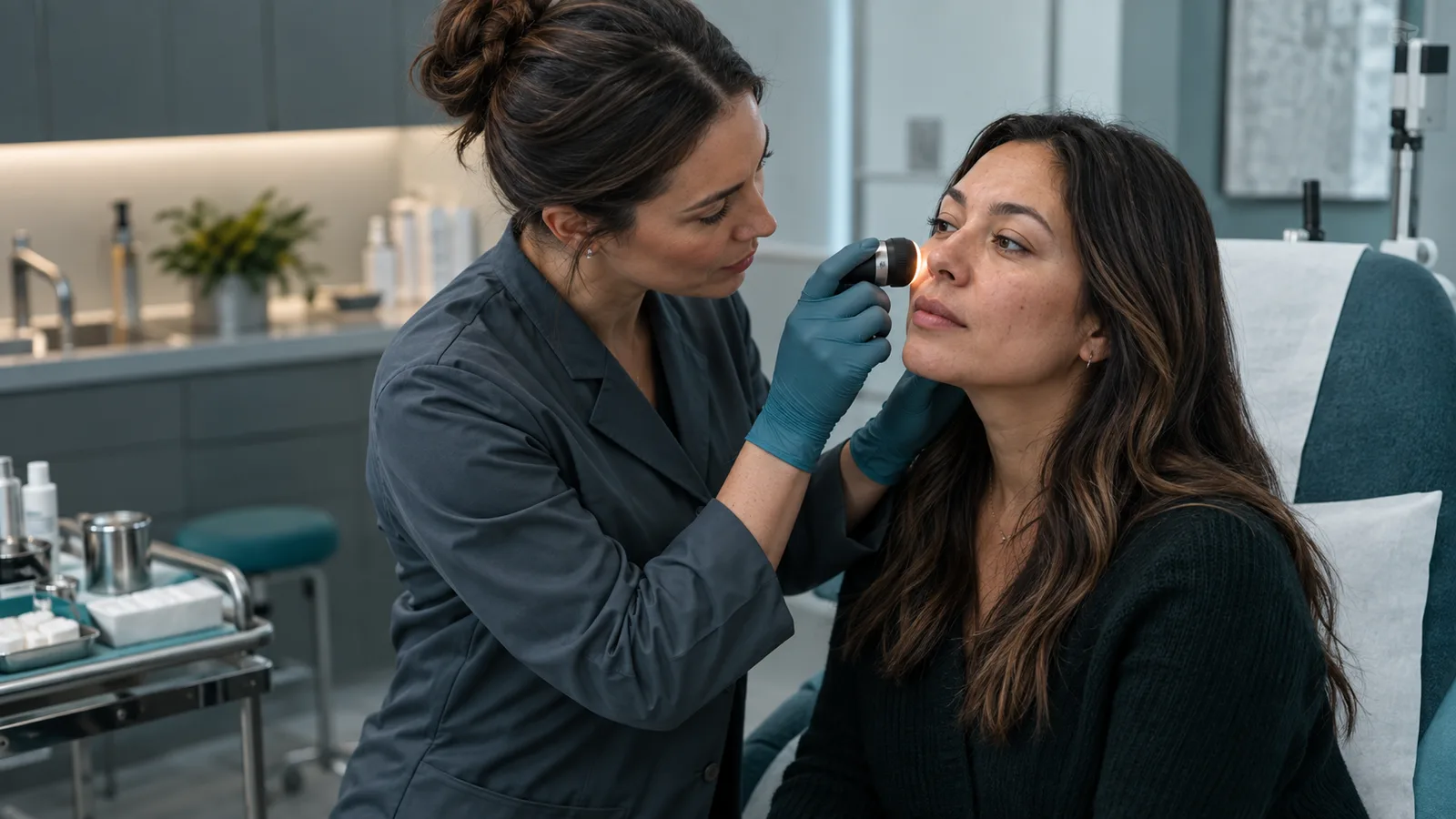
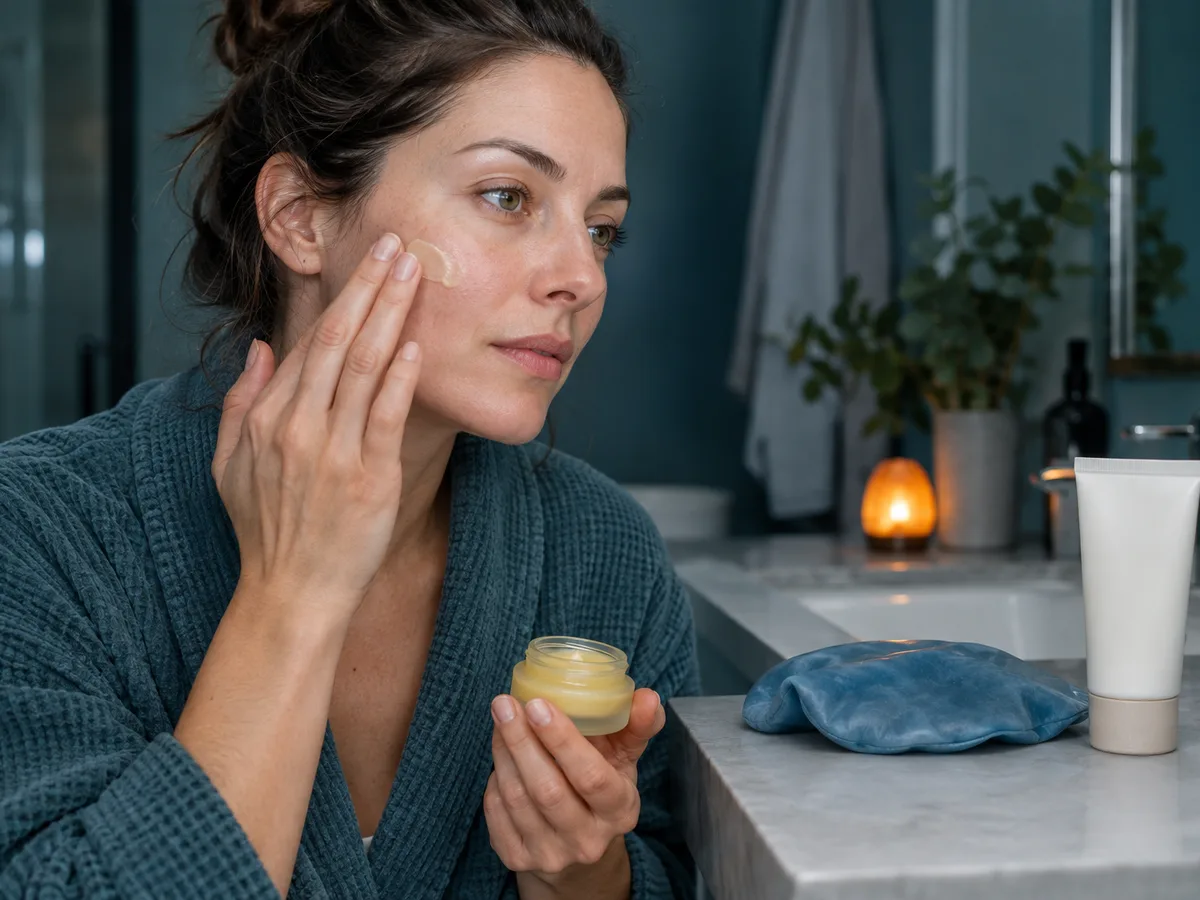
The skin is pink and warm for hours. The spots that were treated darken to the color of coffee grounds over the first day or two.
The rule is leave it alone. Moisturizer, sunscreen, and no picking at the darkened spots, which will lift on their own.
Most people are back to their ordinary routine that evening.
Days four to seven
This is the week of the itch. As inflammation settles and repair accelerates, healing skin itches, and the temptation to scratch, rub or exfoliate is strong.
Do none of them. An antihistamine at night helps.
After an ablative laser, the surface re-epithelializes during these days. The weeping stops, a fine crust forms and lifts, and new pink skin shows underneath.
The occlusive ointment gives way to a lighter moisturizer as the surface closes. After a non-ablative laser, the skin turns dry and rough as the coagulated columns shed, and it feels like fine sandpaper under the fingertips.
After IPL, the darkened spots flake away and the redness fades.
With that context, the working test for this week is simple. Is the skin getting better each day, even slowly? If so, continue.
If any area is getting worse, call the practice that day. Worse means more painful, more swollen, weeping anew, or showing yellow crust or spreading redness after it had begun to settle.
Infection after ablative treatment and a cold sore flare after any facial treatment are both time-sensitive. Both are easier to manage when caught early.
The second week
Ablative skin is closed but new, pink and thin. Non-ablative skin has finished shedding and looks smoother than it did, and IPL skin looks clearer.
In every case the skin is now more sensitive to ultraviolet light than it was, and will remain so for weeks to months. This is the week when most people feel well enough to stop being careful.
It is also the week when the Los Angeles sun does its damage.
Active ingredients return gradually. Most practices allow a gentle vitamin C in the second week and a retinoid in the third or fourth, later after ablative treatment.
Exfoliants come last. The face should feel fully comfortable before anything with a sting goes back on it.
The sun, specifically
Los Angeles does not have a low-sun season. The ultraviolet index here sits at levels that burn unprotected skin most days of the year, and healing skin burns faster and pigments more.
Post-inflammatory hyperpigmentation is the commonest way a good laser result becomes a bad one. Sun exposure in the first month is the commonest way it happens.
The practical rules are short. A broad-brimmed hat outdoors, not a cap.
A mineral sunscreen with zinc oxide, applied thickly and reapplied, from the day the practice allows it. Shade at midday, which in this city means indoors.
Windows are not protection from the longer ultraviolet wavelengths. A drive down the 10 with the window up still delivers a dose to the left side of the face.
The bar for how long this continues is longer than most people expect. At least a month after non-ablative or light treatment, and two to three months after ablative treatment, with sunscreen as a permanent habit thereafter if the result is to last.
Products worth having and products to avoid
Worth having before the treatment day: a plain occlusive ointment for ablative recovery, a bland fragrance-free moisturizer, a gentle non-foaming cleanser, a mineral sunscreen, a soft hat, clean pillowcases and an antihistamine.
Worth avoiding for the first two weeks: anything with fragrance, alcohol, acids, retinoids, vitamin C, scrubs, cleansing brushes, saunas, steam rooms, hot yoga, swimming pools and the ocean.
Worth avoiding for a month: sun, tanning of any kind including spray tans over healing skin, and any new skincare product.
Two notes on the products themselves. Home-use light and heat gadgets marketed for the same complaints as clinic devices are consumer products with their own recall history.
A reader tempted to speed recovery with one can search the CPSC recall list first. Ask the treating practice before using anything that emits light or heat on healing skin.
The eye protection question does not end at the clinic door either. Anyone using a home LED mask during recovery should know that the cheaper devices do not always cite an exposure standard.
The standards for safe exposure to optical radiation are published through the American National Standards Institute, and a device that names one is a device whose maker has at least read it.
What the practice should have told you
A written aftercare sheet specific to the device used, not a generic one. A phone number that reaches a clinician after hours for the first week.
A named list of what to apply, when, and when to stop. A stated sun avoidance period with a date on it.
A follow-up appointment at one to two weeks for ablative treatment. A description of what a normal recovery looks like on day two, day five and day ten, so that you have something to compare against.
If any of those was missing, ask for it. Take its absence into account when deciding where to have the next treatment. The same list works as a checklist when comparing clinics, from a hospital dermatology department to a laser and injectables practice in Los Angeles.
Why the physics of the wavelength matters for healing
Readers sometimes ask why an ablative and a non-ablative laser, which both produce a grid of columns, heal so differently. The answer is water absorption.
The carbon dioxide wavelength is absorbed so completely by water that the tissue in its path turns to vapor, leaving an open channel. The 1,550 nanometer wavelength is absorbed less strongly and heats the column without opening it.
The optics behind that difference are laid out clearly in the educational pages of Optica, a professional society with nothing to sell a patient.
A reader who understands the absorption curve will understand why the aftercare sheet for one laser cannot be used for another. The curve is the reason the two recoveries look nothing alike.
The engineering side of the same subject, including how pulse duration changes what a column of heated tissue does, is covered by the photonics engineers at SPIE. It is more than a patient needs and less than an operator should know.
Bench summary
Moisture for open skin, calm for closed skin, patience for flaking skin. No actives, no heat, no picking, no sun.
Watch for worsening rather than slow improvement. Reintroduce products in the third week, and later after ablative treatment.
Treat the sun as the enemy of the result for at least a month, and as a permanent consideration after that. The two weeks are the treatment as much as the hour was.