
Treatment Area
Laser Resurfacing and Light Treatments, Wavelength by Wavelength
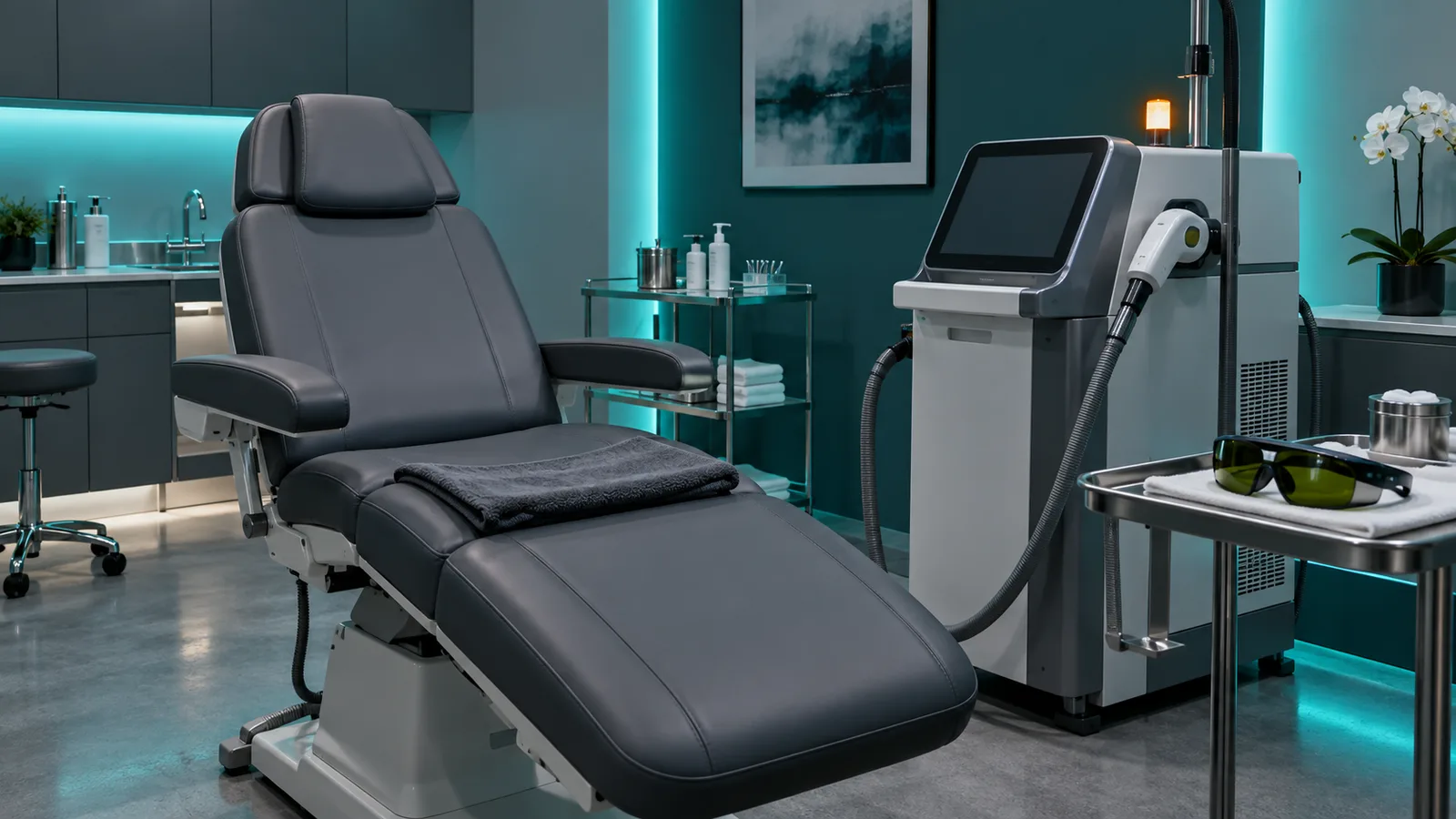
A fractional laser removes or heats narrow columns of skin and lets the untouched skin between them drive repair. Intense pulsed light, which is not a laser, pushes filtered flashes into pigment and blood vessels near the surface.
Both act on the skin itself: its texture, its color, its scars and its sun damage. Neither lifts anything.
This hub gathers the guides on choosing between ablative and non-ablative fractional lasers, on what IPL does and for whom, and on the two weeks after any of them.
Explainers filed here
03 explainers| # | Explainer | Scope |
|---|---|---|
| 01 | Ablative or Non-Ablative: Choosing a Fractional Laser for Sun Damage and Scars | Carbon dioxide and erbium lasers against the 1,550 and 1,927 nanometer non-ablative family, the trade between downtime and depth, and which problems each one repairs. |
| 02 | IPL and Photofacials: What Broad-Spectrum Light Does for Redness and Sun Spots | How a filtered flashlamp differs from a laser, what it treats well, why it is the riskiest common device for deeper skin tones, and how to judge an IPL consultation. |
| 03 | Aftercare After a Laser Treatment: The First Two Weeks | Day by day, what healing skin does after ablative, non-ablative and light treatments, what to put on it, and how to handle the Los Angeles sun. |
How to think about the category
Overview
The organizing idea is depth and target. Every laser has a wavelength, every wavelength is absorbed preferentially by something, and the something decides what the laser can do.
Water, melanin and hemoglobin
Water is the target for the resurfacing lasers. That is why they affect all skin and why they can be tuned to remove tissue or merely heat it.
Melanin and oxygenated hemoglobin are the targets for the lasers and light sources used on spots and redness. Those treatments are selective for the same reason, and they carry a specific risk for skin that holds more melanin than the device was designed around.
What the trials measure
When comparing options, the next point is what the trial literature measures. Resurfacing studies report changes in wrinkle scores, pigment scores and patient satisfaction, most often at three to six months.
Ablative fractional treatment tends to show larger changes per session with more downtime. Non-ablative treatment shows smaller changes per session, so it is usually sold as a series.
IPL shows reliable improvement in redness and discrete sun spots and unreliable improvement in anything else. These are directions, not guarantees, and any individual face can sit outside them.
Two facts to carry into every consultation
First, the wavelengths and pulse physics are not secret. A reader who wants to know why a 10,600 nanometer beam vaporizes tissue while a 1,550 nanometer beam only heats it can start with the educational material at Lawrence Livermore National Laboratory.
The optics societies publish the absorption curves without selling a treatment. A clinic handout that contradicts them is wrong, however glossy.
The same subject is covered from the engineering side by Optica, whose member journals are where much of the device physics was first published.
Second, laser safety is a discipline with its own standards and its own history, much of it built at the national laboratories. A clinic that treats eye protection as optional has not absorbed that lesson.
The people who take lasers most seriously are the engineers who build the most powerful ones, and the public material from their professional society, SPIE, makes that plain.
If the question is elsewhere
If the concern is loose skin rather than its surface, start with the tightening hub. No resurfacing treatment addresses laxity.
If the question is who may operate a laser in California and how to check a device's clearance, the provider hub covers it. If a treatment is already booked, read the aftercare guide first, and read its section on sun twice.
A last word on sequence
Readers often ask whether to resurface first and tighten later, or the reverse. Most providers who offer both will treat laxity first and surface second.
Resurfacing over skin that is about to be heated from beneath doubles the recovery for no gain. The order is a consultation question, and a good answer will mention your skin, your schedule and the season rather than the price list. A practice that offers lasers alongside injectables should be able to give one.
The California rule, briefly
The Medical Board of California treats the use of lasers and intense pulsed light to alter living tissue as the practice of medicine. The operator should be a physician, or a nurse, nurse practitioner or physician assistant under physician supervision.
An esthetician holding a resurfacing laser sits outside that position, however confident the spa. The provider hub sets out how to check a license before the first appointment.